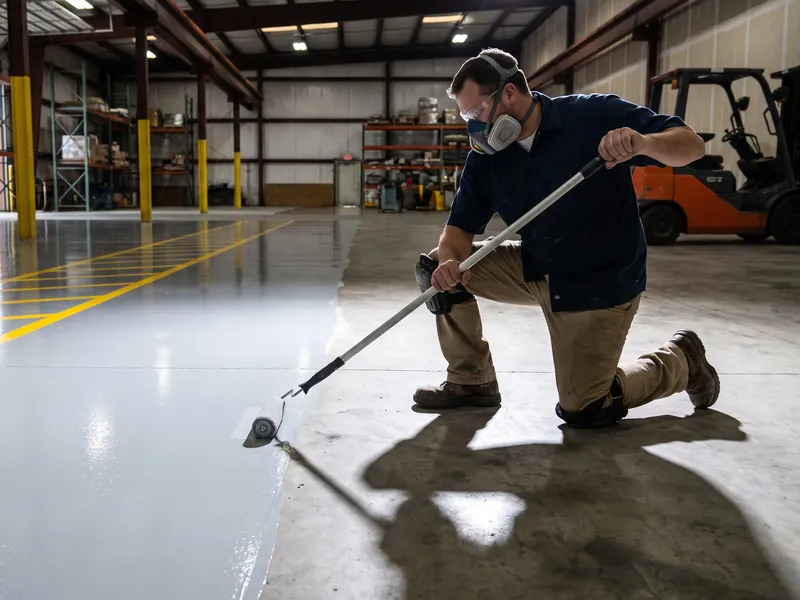
An industrial floor coating protects concrete in manufacturing plants, warehouses, and production facilities from forklift traffic, chemicals, impacts, and constant cleaning. Choosing the right system, and installing it with minimal downtime, keeps a facility safer and saves the cost of repairing worn, dusty, or cracked concrete.
In short: industrial floor coatings are multi layer systems, usually epoxy, polyurea, or polyaspartic, bonded to mechanically prepared concrete. The right choice depends on traffic, chemical exposure, temperature, and how fast the floor must return to service. Safety markings that follow OSHA’s color code are often added in the same project.
Why industrial facilities coat their concrete floors
- Durability: bare concrete dusts, stains, and wears under forklifts and pallet jacks. A coating takes that abuse instead.
- Chemical and oil resistance: coated floors resist spills that soak into bare concrete.
- Cleanability: a sealed surface is faster to clean, which matters in food, production, and distribution spaces.
- Safety: anti slip textures and clear markings reduce trips and separate people from equipment.
- Brightness: light colored coatings reflect more light, which helps visibility in large spaces.
Types of industrial floor coating systems
| System | Strengths | Common uses |
|---|---|---|
| Epoxy | Thick, hard, strong adhesion, cost effective | Warehouses, production floors, shops |
| Polyurea and polyaspartic | Fast cure, short downtime | Facilities that cannot shut down for long |
| Anti slip finishes | Added texture for traction | Wet areas, ramps, loading docks |
| Line striping and markings | Organize traffic and flag hazards | Aisles, forklift lanes, equipment zones |
Many floors combine systems: a durable base, a topcoat suited to the traffic, and markings applied once the coating is in place.
Surface preparation decides how long the floor lasts
Coating failures in industrial spaces often trace back to prep. The concrete has to be mechanically profiled, typically by diamond grinding, so the coating can bond. Oil contamination, old coatings, cracks, and joints are addressed before any material goes down. Skipping or rushing this step is a common cause of peeling under forklift traffic.
Safety markings and OSHA colors
Floor markings turn a coated floor into an organized, safer workspace. OSHA’s safety color code standard, 29 CFR 1910.144, sets two basic colors:
- Red is the basic color for identifying fire protection equipment, danger, and emergency stop functions.
- Yellow is the basic color for designating caution and marking physical hazards such as striking against, stumbling, falling, tripping, and caught in between.
Facilities often add their own color plan for aisles, storage, and work cells on top of these. Planning markings together with the coating avoids a second shutdown later.
Minimizing downtime during installation
Downtime is often the biggest cost of a floor project. These steps keep a facility running:
- Phase the floor in sections so production can move around the work.
- Schedule work during shutdowns, weekends, or off shifts.
- Choose fast cure systems where a long cure is not an option.
- Agree on a return to service time for foot traffic and for vehicles before work starts.
Temperature affects curing, so cold buildings may need heat or a different product. Our guide to coating temperature in Idaho explains why.
Industrial floors vs commercial and garage floors
Industrial floors face heavier loads and harsher conditions than retail or office floors, so they usually need thicker, more robust systems. For lighter business spaces, see our guide to commercial epoxy floor coatings, and for homes, our epoxy garage floor cost guide.
Coating the rest of the facility
Floors are often coated alongside structural steel, metal buildings, tanks, and equipment. Lagunas Painting’s industrial painting service covers manufacturing and production facilities, metal structures and tanks, and floor coatings and safety markings, with onsite evaluations and scheduling built to minimize downtime. Businesses with mixed spaces can also combine floor work with commercial painting.
Request an industrial floor assessment
Every facility is different, so industrial floor coating projects start with an onsite evaluation of the concrete, traffic, and schedule. We serve manufacturing, warehouse, and production facilities across Caldwell, Nampa, Meridian, Boise, and Eagle. Request a free industrial assessment or explore our commercial floor coating service.
Frequently asked questions about industrial floor coating
What is the best coating for an industrial floor?
It depends on traffic, chemicals, temperature, and downtime. Epoxy is a durable, cost effective choice for many warehouses and production floors, while polyurea and polyaspartic systems cure faster when a facility cannot shut down for long.
How long does an industrial floor coating take to install?
It depends on the floor area, the prep needed, and the system’s cure time. Large floors are often phased in sections or scheduled during shutdowns so the facility can keep running.
What safety colors does OSHA specify?
OSHA’s safety color code, 29 CFR 1910.144, makes red the basic color for fire protection equipment, danger, and emergency stops, and yellow the basic color for caution and physical hazards like tripping and falling.
Why do industrial floor coatings peel?
Many failures come from poor surface preparation, such as coating over oil, old sealers, or concrete that was not mechanically profiled. Diamond grinding and proper repairs before coating prevent most of these problems.
Can forklifts drive on an epoxy floor?
Yes, once the coating has fully cured. Industrial systems are built for forklift and pallet jack traffic, but the floor should not take vehicle loads until the manufacturer’s cure time has passed.
What is an industrial flor coating?
An industrial flor coating is a protective layer, usually epoxy, polyurea, or polyaspartic, applied to prepared concrete to resist wear, chemicals, and impacts in plants and warehouses.
Sources consulted
- OSHA: 29 CFR 1910.144, Safety color code for marking physical hazards
- Lagunas Painting: Industrial Painting Services